Thursday, August 20, 2009

Friendship Bag Swap: Getting ready

I must be crazy; I am doing a swap? And WHEN do I have time to do this??!!!

Ah well; a girl's gotta have some fun now and then, yes? Misery loves company; you should join me. :)


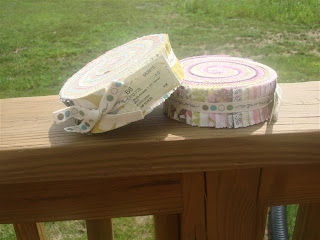
I bought my Moda Honey Buns, so after the yardage arrives (for handles, bottom of bag, etc), I'm ready to go. I chose the Sultry and Arcadia Honey Buns by Moda; they were on sale at Fabric.com.

Come on; it'll be quick and fun!

Wednesday, August 5, 2009

Me & My Sister's Fun Quilts: A book review


In any hobby, the books which are written to give you basic information on the topic are greatly appreciated, especially those that are well written. There are also the reference-type books which give you specific information on particular aspects of the hobby, through an alphabetical or categorical arrangement. But then there are those books which, while informative and helpful, are just pleasant to look at and provide a intriguing, even fun avenue into the hobby. Me And My Sister's Fun Quilts is such a book!

In this 80-page Leisure Arts publication, written by sisters Barbara Groves and Mary Jacobson, there are 9 colorful quilts, with beautiful, full-color photographs and step-by-step directions on how to create them. The techniques range from simple to slightly more complex. Yet even a beginner will be comfortable attempting any of the quilts featured in the book. The directions are clear, simple, and very comprehensive. There is no ambiguity in what should be done, and how it should be accomplished. And if there is any question, the final chapter is instructional in nature, and is full of techniques and tips to enable even the most unexperienced quilter the means to create a well put-together quilt.

Yet intermediate and advanced quilters will not want to pass this book up. The presentation is simply wonderful, with whimsical designs and color schemes. There is not a lot of the traditional calico look here; instead, readers will find delightful duck prints, polka dots, jewel tone color schemes, and candy-fun quilt names (my favorite is Pink Lemonade). Nonetheless, even traditional quilters will find this book incredibly appealing.

If you are looking for a quilting book with lots of fun, cheery-looking projects, I believe this book will fulfill that purpose for you. More than many other quilting books, this book will definitely be advantageous to the quilter who would be turned off by country calicos and blue bonnet-wearing ducks. Take a look at Me And My Sister's Fun Quilts and you will definitely want to embark immediately upon any one of the projects!

Wednesday, July 15, 2009

Cutter quilts: New life for old quilts beyond repair?

I want to share with you an interesting concept in the world of quilting. It is called a "cutter quilt."

A cutter quilt is a portion, or a "cut" of a quilt that is no longer able to be salvaged, saved, repaired, or restored. In essence, there is nothing else that you can do with the quilt--at least in its current, uncut form. It thus gets cut into pieces, discarding those sections that are irreparable, and keeping the pieces that are still in decent condition. Cutter quilts are commonly portions of antique or vintage quilts that are so badly damaged, they might be in shreds in some portions. Yet, these quilts may have sections that are still in good enough condition to be saved and used and even repurposed. Some cutter quilts find a new life as doll quilts, table toppers, wall hangings, Christmas stockings, just to name a few. You might even be fortunate enough to find an entire quilt that is being sold as a cutter due to threadbare portions of the quilt, leaving you the opportunity to cut the quilt yourself.

Hence the birth of the cutter quilt. A cutter quilt, besides taking a textile that is no longer usable and making it usable, also has an interesting tale about its maker and the materials she had available to her. For example, many cutters of antique quilts have scraps of fabric from ties and feed sacks, for example. Some have wool batting, indicating perhaps a flock of sheep was being kept by the family, or perhaps by a neighbor. Some are fairly heavy, even for a cutter quilt (after all, the quilt would have been used in unheated homes, where the temperature inside the house could easily fall below freezing during the winter).

If you have an interest in acquiring vintage quilts and textiles, perhaps your entry to this world may be through cutter quilts. They do not cost nearly as much as an intact antique quilt, yet they are every bit as beautiful.

Photo source: Primitive Pieces of the Past

Wednesday, July 1, 2009

Quilt block study: The Jacob's Ladder quilt block

The Jacob's Ladder quilt block is believed to have been in existence since the late 19th or the early 20th century. It has not always been known by this name; it has also been called Underground Railroad, or Stepping Stones, just to name a couple. Because quilt block pattern books simply did not exist until more recent years, it is difficult to determine just when this block was first pieced. Quilt historian Barbara Brackman does not believe that this block was created before the early 1900s.

Jacob's Ladder is believed to have been named such for the biblical reference to a ladder "resting on the earth, with its top reaching to heaven, and the angels of God were ascending and descending on it" (Genesis 28:12, NIV). It is easy to see how the upward motion of the block symbolizes ascending a ladder. Similarly, the Stepping Stones name is appropriate, as the small blocks are easy to visualize as small stepping stones. Also, the block, with its upward motion, could be used to symbolize the Underground Railroad, and the movement of slaves up to freedom from slavery.

Photo source: About.com

Monday, June 1, 2009

Question: Who makes Amish quilts?


Answer: Not necessarily the Amish.

Surprised? I sure was!

Turns out, that sometime during the 1970s, a faction of Hmong refugees found their way to Pennsylvania Dutch country after the war in their homeland left them homeless. The Mennonites of the Central Pennsylvania region--Mennonites are well known for opening their arms to assist refugees of all races and cultures--took them in, and were pleased to find that the Hmong were quite capable with a needle and thread. And the Mennonites, as you know, are rather closely affiliated with the Amish.

So, one thing led to another. In order to provide the Hmong with the opportunity to support themselves, they were permitted to use their skill to assist in the Amish quiltmaking industry. After a time, these families apparently made contact with family and friends back at home, and got them involved in the craft. Entire villages were transformed, as male and female, young and old alike, began sewing Amish quilts to send back to the States. The Hmong even moved the industry forward, by introducing their skill in applique work in the 1980s, a skill which the Amish did not possess.

As this phenomenon becomes more well known, shops which sell Amish quilts are becoming more vigilant as to whom they allow to stock their shelves with quilts. And rightfully so. While I greatly admire the industry, and how it has greatly improved the quality of life for the Hmong, I think I'd like to know that the $600 "authentic" Amish quilt that I am considering buying was not made by the Amish. The book shown above, World Of Amish Quilts, which comes very highly rated (by others; I have not had the opportunity to review it yet), has a beautiful "Trip Around the World" quilt on its cover.

Source: http://tinyurl.com/9nbtwo

Sunday, May 17, 2009

All About Quilting from A to Z: A book review


All about Quilting from A to Z is an informative guide to quilting, with a dictionary/encyclopedia layout. Quilting topics are very easy to find with this format.

After the User's Guide, there are full-page, full-color photographs of well known quilters and their homes/studios. The next section displays a collection of classic quilts--album, Amish, charm, crazy, mariner's compass, medallion, postage stamp, sampler, story, string, strip, and whole cloth. This is followed by illustrations of 60 quilt blocks, everything from Dresden Plate to Spools to Whirlygig, and how to use colors and lay them out. Fabrics are discussed, tools are shown, and basic quilting techniques are demonstrated.

The rest of All about Quilting is in alphabetical format. Topics included range from applique, to basting and binding, to foundation piecing, to labeling, to yo-yos and zigzag sets. There are obviously dozens of topics in between, but it is obviously not feasible to list them all here. Rest assured that whatever topic you are looking for, this book most likely covers it.

For those who appreciate current, up-to-date reference books with lots of full-color photographs and illustrations to provide further explanation, All about Quilting will be a book to consider owning. Also, for those who appreciate an alphabetical approach to a discussion of quilting topics, All about Quilting also meets this criteria. Further, the book offers lots of helpful written explanation on all topics presented. Especially to be appreciated are the pages which offer a glimpse into the lives of professional quilters.

Saturday, May 2, 2009

Happy Hour - Relax and Enjoy: Picture This quilt

If you have ever had the opportunity to make a quilt from a pattern created by Terry Atkinson, you know what a joy it is to work with her patterns. I'd decided a few months ago to take a class at my LQS which featured the Happy Hour: Relax and Enjoy quilt booklet, and the Picture This quilt in particular.


The quilt pictured on the cover is the quilt I will be making. I, too, chose batiks, but I chose tans, browns and reds. It will match the great room in my house. However, I think I will be adding a narrow inner border and a wide outer border; I like the look of the two borders in a quilt.

Yesterday, I took this class. For all of the sewing and quilting I've done, it was the first time I'd ever taken a quilting class, and it was all that I'd anticipated that it would be. Granted, I did not learn anything new, and I moved quickly enough to complete all of my blocks by the end of the day, but I greatly enjoyed the experience. I will definitely do it again.

As of today, I have ironed all 30 blocks, and I am partway through the process of trimming them down to a uniform size. I'll keep you posted.

Wednesday, April 22, 2009

Quilting 101: A book review


Whether you are trying to decide if quilting is something you’d like to try, or maybe you’ve already decided to take the plunge, you will need a good instructional book on the basics of quilting. Quilting 101: A beginners guide to quilting is such a book. As its name implies, Quilting 101 is an ideal guide for introducing the beginner to the first steps of creating a quilt. Even for those who are more experienced, this book very clearly illustrates some of the elements of the craft that quilters may find confusing, and may want to receive more details on the subject.

Quilting 101 begins with an introduction as to how to use the book as a reference. Assuming no foreknowledge of quilting, the book introduces the reader to Sewing Basics: the sewing machine and its accessories, including presser feet and needles; how to sew a seam; quilting supplies; fabric and batting information; rotary cutting; layering and basting; basic quilting techniques; and binding. Even for those who have sewn a number of quilts, you will still find this discussion of the basics to be very helpful and informative.

The rest of the book is dedicated to basic quilting projects: kitchen accessories (hot pads, coasters, placemats, table toppers, and table runners); lap quilts; pillows; zippered bags; Christmas stockings; wall hangings; sewing machine covers; pillows; even doll quilts. Through these projects, quilters are introduced to the most common quilt blocks, such as Rail Fence, Log Cabin, Nine Patch, Ohio Star, Churn Dash, Flying Geese, and Bow Ties. Also, the projects allow the quilter to sew using common quilting techniques, such as applique, quilt-as-you-go, sewing triangles, sashing, paper piecing, strip piecing, and chain piecing.

Everything that is described in Quilting 101 is also illustrated in full color photographs, making the quilting process that much easier. Quilting 101 is an excellent book and comes highly recommended to you; you could easily own this book alone, and possess virtually everything you need to know about basic quilting. Many thanks to Creative Publishing for yet another great publication!

Wednesday, April 15, 2009

For the love of quilting

Recently, I was asked for a sewing machine contest by YCQT to share why I love quilting. So, I stopped to really think about it.

I thought about how it gives me a diversion from all of the crazyness that life has to offer at times. If you quilt or sew, or really do any type of crafting, you can relate; just by planting myself in front of the sewing machine, or by handling fabric, I can feel the tension begin to melt away. There is something tranquil, almost therapeutic in the cutting and arranging of fabric, or in the soft whirring of the sewing machine.


I thought about how, while quilting is something I do in solitude, I can also do it with others. Sometimes my daughters quilt and sew with me.

I thought about how sometimes I quilt and sew with my sewing circle (our group is mentioned in previous posts on this blog) in our quest to provide quilts and other sewn items for those in need in our area. We have sewn for families of deceased infants, abandoned babies, the elderly, the homeless, families living in shelters–the list goes on and on. We do not have outside financial backing, and many of us are not much better off than those for whom we sew; our fabric comes to us through donations. (If you have any fabric you'd like to donate, by the way, let me know; we'd be ever so grateful.)

I thought about how it would be great to work with a brand new machine. New machines often sew faster, and, for the most part, do not need frequent repairs, so you can sew more in the same amount of time. But whether our machines are new, fairly new, vintage, or otherwise, we will continue with our mission. Even with older, vintage machines (from the 60s, quite often), we do all that we can for the babies, children, women and men of our community.
Related Posts Plugin for WordPress, Blogger...